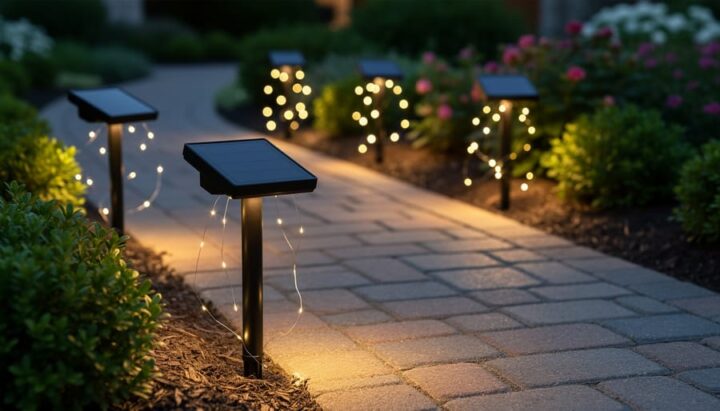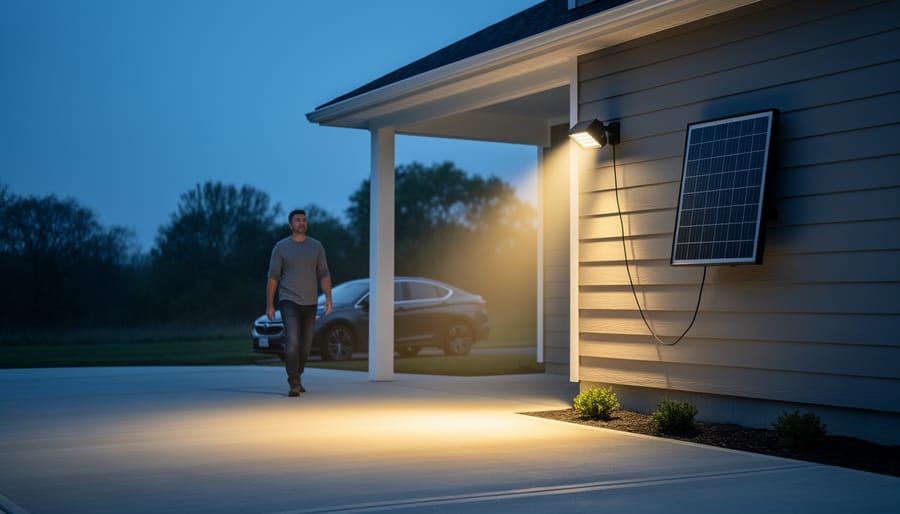
Position your solar flood lights where they’ll capture maximum sunlight during peak hours—typically facing south in the northern hemisphere—to ensure the battery charges fully for reliable nighttime operation. Mount the solar panel separately from the light fixture when shadows from eaves or trees limit roof exposure, using the extended cable most quality units provide to optimize energy collection.
Install motion sensors 8-12 feet high at a 25-30 degree downward angle to create an ideal detection zone that covers entryways, driveways, or dark corners without triggering from distant movement like swaying branches or passing cars. This placement maximizes the 180-degree detection range while minimizing false activations that drain battery reserves unnecessarily.
Choose models with adjustable sensitivity settings and customizable timer durations—typically ranging from 10 seconds to 5 minutes—allowing you to fine-tune performance based on your specific security needs and foot traffic patterns. Higher-end units often feature 2000-3000 lumens output with efficient LED technology that converts stored solar energy into bright, reliable illumination.
Solar flood lights with motion activation represent a breakthrough in sustainable outdoor security, eliminating electrical wiring costs while reducing your carbon footprint. Modern photovoltaic cells achieve 20-22% efficiency rates, storing enough power to operate through cloudy periods when paired with quality lithium-ion batteries. These intelligent lighting systems combine eco-friendly operation with advanced passive infrared sensors that detect heat signatures, creating powerful security solutions that cost nothing to run after installation.
Why Motion Activation Changes Everything for Solar Flood Lights
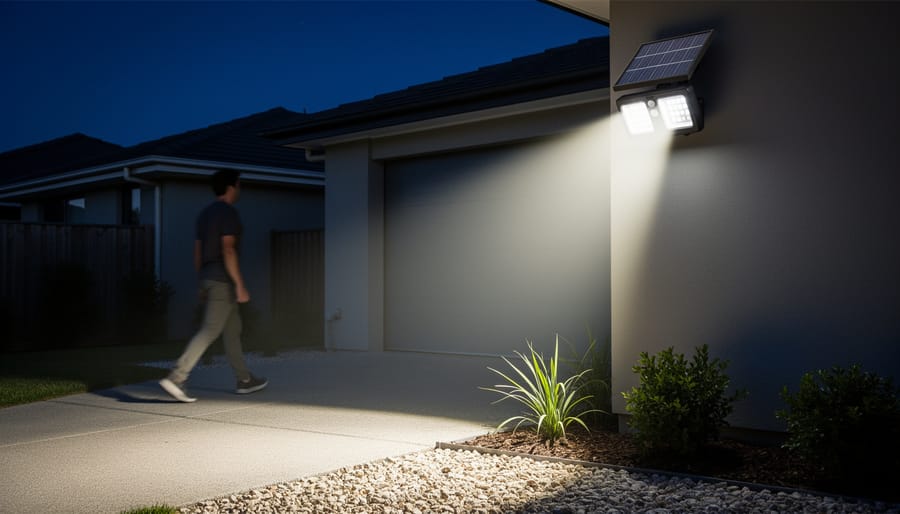
How Motion Sensors Preserve Battery Power
Motion-activated solar flood lights dramatically extend battery life through passive infrared (PIR) sensors—a smart technology that detects heat signatures from moving objects. Here’s how it works: these sensors monitor infrared radiation in their detection zone, remaining in standby mode until they register a temperature change caused by a person, vehicle, or animal passing by. When motion is detected, the light instantly activates, then automatically switches off after a preset duration.
This intelligent on-demand operation translates to remarkable energy savings. While always-on solar lights drain their batteries throughout the night, motion-activated models illuminate only when needed—typically just a few minutes per hour in most residential settings. The result is a 3-5x extension in operational hours from the same battery capacity. For example, a solar flood light with a 6-hour battery runtime when continuously on can last 18-30 hours in motion-activated mode, ensuring reliable illumination even during cloudy periods when solar charging is reduced.
This efficiency boost benefits both your wallet and the environment by maximizing renewable energy utilization. The technology requires minimal power in standby mode—often less than 0.5 watts—making PIR sensors an eco-friendly solution that doesn’t compromise on security or convenience.
The Security Advantage Nobody Talks About
Here’s a security insight that might surprise you: motion-activated solar flood lights actually outperform always-on lighting when it comes to deterring intruders. The psychology is simple yet powerful—sudden, bright illumination triggers an immediate startle response that constant lighting never achieves.
When a potential intruder approaches your property and trips a motion sensor, the unexpected burst of light creates the impression that someone noticed their presence. This perceived detection is far more unsettling than walking through an already-lit area. Security experts confirm that criminals avoid properties where they feel observed or exposed.
Consider a practical example: a burglar casing homes in your neighborhood will quickly adapt to houses with standard outdoor lighting, mentally mapping their coverage zones. However, motion-activated systems remain unpredictable—they can’t determine sensor placement or detection ranges without triggering the lights, essentially announcing their presence.
The eco-benefit here is twofold: you achieve superior security while consuming zero grid electricity and extending your solar battery life significantly. By illuminating only when needed, these systems maintain full brightness capacity for genuine threats rather than wasting energy lighting empty spaces all night long.
Key Features That Separate Great Models from Mediocre Ones
Lumens and Coverage Area
Choosing the right brightness level ensures your solar flood lights deliver effective illumination while maximizing energy efficiency. For pathway lighting, 400-700 lumens provides adequate visibility without excessive glare, creating a welcoming ambiance while conserving solar power. Driveways and parking areas require 700-1,500 lumens to properly illuminate vehicle maneuvering zones and enhance safety during nighttime arrivals.
Security applications demand higher output, typically 1,500-3,000 lumens, to eliminate dark corners where unwanted activity might occur. This brightness level also triggers the psychological deterrent effect that motion-activated lighting provides. For large yards or commercial properties, consider 3,000+ lumens to achieve comprehensive coverage.
Coverage area depends on both lumen output and beam angle. A 120-degree beam angle works well for most residential applications, spreading light across 20-30 feet. Narrower angles create focused illumination for specific targets, while wider angles provide broader coverage but reduce intensity at distance.
Remember that higher lumens mean greater solar panel and battery requirements. This eco-friendly trade-off encourages thoughtful placement rather than over-lighting, reducing light pollution while maintaining security. Modern LED technology in solar flood lights delivers impressive brightness using minimal energy, making sustainable outdoor lighting both practical and powerful.
Detection Range and Sensitivity Settings
Most quality solar motion lights detect movement within 20-40 feet, with premium models reaching up to 60 feet. This detection range works through passive infrared (PIR) sensors that register heat signatures from moving objects, making them highly responsive to human activity while supporting energy conservation by activating only when needed.
Adjustable sensitivity settings are your best tool for optimizing performance. Higher sensitivity captures movement at greater distances but may trigger unnecessarily, while lower settings reduce false activations. Start at medium sensitivity and fine-tune based on your specific environment. Position sensors parallel to expected movement paths rather than directly facing them for optimal detection—crossing the sensor’s field of view triggers activation more reliably than approaching head-on.
False triggers from pets, wildlife, or wind-blown vegetation are common frustrations. Combat these by angling sensors slightly downward to focus on human-height movement and adjusting sensitivity to ignore smaller heat signatures. Installing lights 8-10 feet high naturally filters out ground-level activity from animals. Some advanced models feature pet-immune technology that distinguishes between different sized objects. Strategic placement away from trees, bushes, and heat sources like air conditioning units also minimizes unwanted activations, ensuring your eco-friendly lighting system performs efficiently without wasting precious stored solar energy.
Battery Capacity and Solar Panel Efficiency
The power source determines how reliably your motion-activated solar flood light performs. Lithium-ion batteries are the gold standard, offering superior energy density, longer lifespans (typically 2-3 years compared to 1-2 years for nickel-metal hydride), and better performance in cold weather. They charge faster and maintain consistent brightness throughout the night, making them worth the slightly higher investment.
For optimal charging, look for solar panels with minimum 5-watt capacity for standard flood lights, or 10+ watts for high-output models. Higher wattage means faster charging and better performance during cloudy periods. The quality of photovoltaic cells matters too—monocrystalline panels deliver better solar panel efficiency than polycrystalline alternatives, converting more sunlight into usable energy even in partial shade.
Several factors impact charging performance beyond panel wattage. Geographic location affects daily sun exposure, while seasonal variations mean winter charging takes longer. Panel placement is crucial—south-facing installation (in the Northern Hemisphere) with minimal shade maximizes energy collection. Dust and debris reduce efficiency by up to 25%, so regular cleaning maintains peak performance. This sustainable approach eliminates ongoing electricity costs while reducing your carbon footprint.
Solar Flood Lights Installation: Step-by-Step Process
Choosing the Perfect Location
Location selection makes or breaks your solar flood light’s performance. First, identify spots receiving 6-8 hours of direct sunlight daily—this ensures the battery charges fully to power motion detection and illumination through the night. Morning through afternoon sun exposure works best for optimal energy capture.
Next, map your detection zone carefully. Most motion sensors cover 180 degrees with ranges between 20-40 feet, so position lights where they’ll catch approaching movement without triggering from street traffic or swaying branches. Mount units 8-12 feet high for ideal coverage—too low reduces detection range, while excessive height weakens sensor accuracy.
Shadow analysis is crucial for outdoor solar lighting success. Walk your property during different times to spot areas where trees, buildings, or roof overhangs cast shade on potential mounting locations. Even partial shading during peak sun hours significantly reduces charging efficiency, cutting your light’s nightly runtime.
Consider seasonal sun angles too. That perfectly sunny spot in summer might sit in shadows come winter when the sun travels lower across the sky. Choose locations with year-round exposure to maintain consistent eco-friendly performance regardless of season, maximizing your sustainable energy investment.
Mounting and Positioning Techniques
Proper mounting ensures your solar flood lights deliver optimal performance while standing up to the elements. The installation process adapts to various surfaces, each requiring specific techniques.
For wood surfaces, pre-drill pilot holes to prevent splitting, then secure the mounting bracket with stainless steel screws that resist corrosion. This eco-friendly fastening method provides lasting stability without compromising your structure. Brick installations require masonry drill bits and plastic anchors rated for outdoor use. Mark your drilling points carefully, ensuring the solar panel faces south (in the Northern Hemisphere) for maximum sun exposure throughout the day.
Vinyl siding presents unique challenges since it expands and contracts with temperature changes. Use mounting blocks designed specifically for siding, which create a stable anchor point without trapping moisture. Never over-tighten screws on vinyl, as this restricts natural movement and can cause cracking.
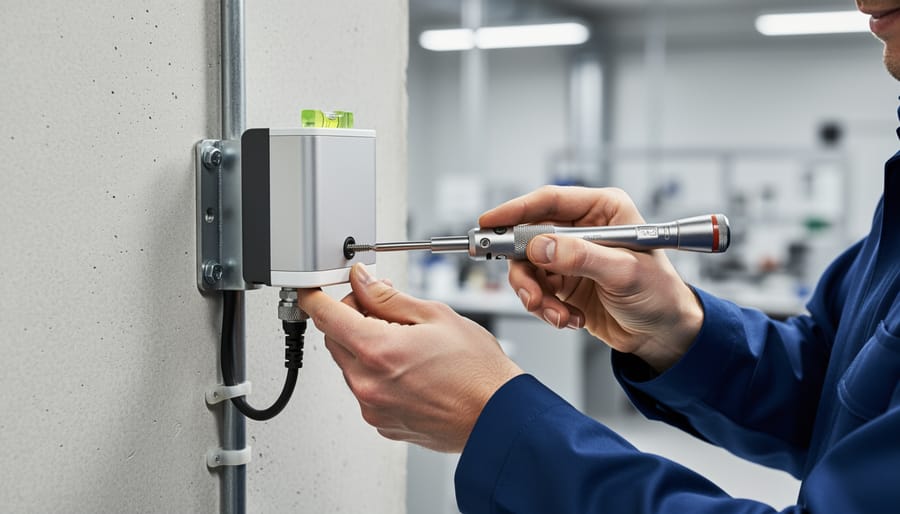
Sensor positioning dramatically affects motion detection effectiveness. Angle the sensor head between 10-20 degrees downward to capture human-height movement while minimizing false triggers from small animals or swaying branches. The optimal detection zone extends outward in a cone shape, so position lights 8-12 feet high for best coverage.
Weatherproofing completes your installation. Apply silicone sealant around mounting holes to prevent water infiltration, and verify all electrical connections use waterproof connectors rated IP65 or higher. Check that the solar panel surface remains unobstructed by eaves or overhangs, ensuring this sustainable lighting solution captures sufficient energy for reliable nighttime operation. These simple steps maximize your investment while reducing environmental impact.
Initial Setup and Calibration
Once your solar flood lights are positioned, proper initialization ensures optimal performance and energy efficiency. Begin by locating the power switch—typically found on the solar panel or light fixture—and activate the unit. Most models require a full charge cycle before first use, so allow 6-8 hours of direct sunlight for the battery to reach capacity.
Next, adjust the motion sensor sensitivity using the control dial or app-based settings. Start with medium sensitivity and test from various distances, walking toward the light from different angles. The detection range typically spans 180 degrees horizontally and 20-40 feet in distance, though environmental factors like temperature and reflective surfaces can affect performance. Fine-tune the sensitivity to minimize false triggers from small animals or swaying vegetation while maintaining reliable human detection.
Configure the timer settings to match your needs. Most motion-activated solar lights offer duration options ranging from 30 seconds to 10 minutes of illumination per trigger. Shorter durations maximize battery longevity—a key eco-benefit—while longer settings provide extended visibility for security purposes.
Conduct thorough testing during evening hours, walking through the coverage area to verify consistent activation. This hands-on approach helps identify any coverage gaps before permanent installation, ensuring your sustainable lighting solution delivers both security and energy efficiency without compromising functionality.
Common Installation Mistakes That Kill Performance
Shaded Solar Panels and Weak Batteries
Partial shade is one of the most common yet overlooked reasons solar flood lights underperform. Even when just 20-30% of the solar panel receives shade from tree branches, roof overhangs, or nearby structures, charging efficiency can drop by 50% or more. This happens because photovoltaic cells operate in series, meaning shaded cells create bottlenecks that restrict the entire panel’s energy production.
To identify placement issues, observe your installation site throughout the day, particularly during peak sun hours between 10 AM and 3 PM. Look for moving shadows from trees that might not be obvious during initial installation. The eco-benefit of solar technology only materializes when panels receive unobstructed sunlight for at least 6-8 hours daily.
If relocation isn’t possible, consider trimming nearby vegetation or mounting panels on extension poles to clear obstacles. Some cutting-edge models now feature adjustable panel brackets that let you angle away from shade sources while keeping the light fixture in your desired position. Additionally, weak or aging batteries store less charge over time. If your lights dim quickly after sunset despite adequate sun exposure, battery replacement might restore optimal performance and extend your system’s sustainable operation for years.
Poor Sensor Positioning
Poor sensor positioning ranks among the most common reasons motion-activated solar flood lights fail to perform as expected. The passive infrared (PIR) sensors in these eco-friendly fixtures detect heat signatures from moving objects, but their effectiveness depends entirely on strategic placement.
Blind spots occur when physical obstructions block the sensor’s field of view. Trees, fence posts, or architectural features can create detection gaps where intruders or wildlife pass unnoticed. Before mounting your light, walk through the coverage area to identify potential obstacles that might interfere with the sensor’s detection cone, which typically spans 120 to 180 degrees.
Heat source interference presents another challenge. Positioning sensors near air conditioning units, exhaust vents, or heat-radiating surfaces causes false triggers as temperature fluctuations confuse the detection system. Similarly, pointing lights toward busy streets where vehicle heat signatures constantly activate the sensor drains battery reserves unnecessarily.
Improper mounting angles significantly impact performance. Installing fixtures too high reduces sensitivity to ground-level movement, while positioning them too low creates excessive triggering from small animals or vegetation swaying in wind. The optimal height typically ranges from 8 to 12 feet, angled slightly downward at approximately 45 degrees. This configuration maximizes detection accuracy while minimizing false activations, ensuring your sustainable lighting solution operates efficiently when genuinely needed.
Maximizing Lifespan and Winter Performance
Seasonal Maintenance Checklist
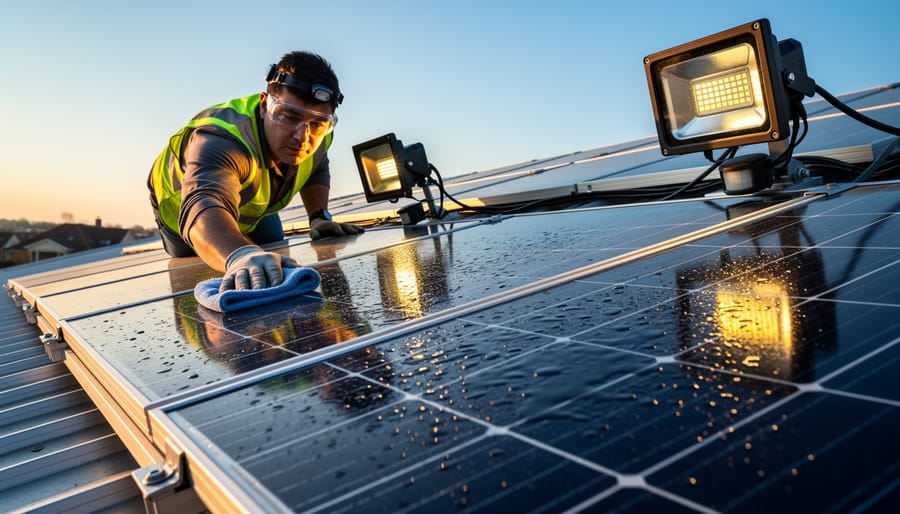
Keeping your solar flood lights in peak condition maximizes both their lifespan and eco-friendly performance. Clean solar panels monthly with a soft, damp cloth to remove dust, pollen, and debris that can reduce charging efficiency by up to 25%. In high-pollen seasons or dusty environments, increase cleaning frequency to every two weeks.
Proper battery care ensures reliable operation year-round. Most lithium-ion batteries in modern units last 2-3 years, but extreme temperatures can accelerate degradation. During winter months, check that batteries maintain adequate charge levels, as reduced sunlight exposure may require temporary repositioning of panels.
Inspect weather seals and gaskets quarterly, especially before winter and monsoon seasons. Cracked or loose seals compromise the IP rating and allow moisture intrusion, potentially damaging internal electronics. Replace deteriorated seals immediately to maintain water resistance.
Clean motion sensor lenses every three months using a microfiber cloth. Dirty lenses reduce detection range and sensitivity, causing false triggers or missed activations. This simple maintenance step ensures optimal performance while keeping your outdoor spaces sustainably illuminated.
Cold Weather and Low-Light Adaptations
Winter conditions challenge solar flood lights, but understanding these limitations helps you maintain optimal performance year-round. Lithium-ion batteries, the powerhouse behind most modern solar lights, experience reduced efficiency in freezing temperatures, typically losing 20-30% capacity below 32°F. This means shorter runtime and potentially dimmed output during cold snaps.
The more significant winter hurdle is reduced daylight charging. Shorter days and lower sun angles can cut solar panel energy collection by 50% compared to summer months. Snow accumulation on panels compounds this issue, blocking sunlight completely until cleared.
Strategic adjustments keep your lights functional through winter. Position lights to maximize sun exposure during peak midday hours, adjusting angles if your model allows seasonal repositioning. Consider reducing motion sensitivity settings to conserve battery power, focusing detection on essential areas. Some eco-conscious users supplement with a second set of lights, rotating them for indoor charging during particularly harsh weeks. Modern weatherproof designs with temperature-resistant batteries perform better in extreme conditions, making quality components a worthwhile investment for year-round reliability. Regular panel cleaning removes ice and snow buildup, ensuring maximum charging efficiency.
The Environmental and Economic Impact
Switching to solar flood lights with motion activation delivers measurable environmental and financial benefits that compound over time. Let’s break down the numbers to understand the real-world impact of this sustainable lighting solution.
A typical 50-watt halogen flood light running for 10 hours nightly consumes approximately 182.5 kWh annually. At the average U.S. electricity rate of $0.14 per kWh, this translates to roughly $25.55 in annual operating costs per fixture. Solar alternatives eliminate this expense entirely, with the cost savings becoming more significant when lighting multiple areas around your property.
The carbon footprint reduction is equally impressive. Based on the EPA’s calculation that electricity generation produces about 0.92 pounds of CO2 per kWh, replacing one conventional flood light with a solar alternative prevents approximately 168 pounds of carbon dioxide emissions yearly. Over a typical 5-year lifespan, that’s 840 pounds per fixture, equivalent to planting roughly 10 tree seedlings.
Motion activation amplifies these benefits by reducing unnecessary illumination. Studies show motion sensors can decrease light operation time by 60-80% compared to dusk-to-dawn settings. This efficiency extends battery life and reduces the solar panel size needed, lowering manufacturing resource requirements.
Installation presents another advantage: wired alternatives require electrical trenching, conduit, and professional electrician costs averaging $200-500 per location. Solar units eliminate these expenses and reduce copper wire demand, a resource-intensive material requiring significant mining and processing energy.
For households installing four solar motion-activated flood lights, the combined annual savings exceed $100 in electricity costs while preventing nearly 700 pounds of CO2 emissions, making this technology both economically sensible and environmentally responsible.
Solar flood lights with motion activation represent a powerful convergence of security enhancement and environmental responsibility. By harnessing renewable energy from the sun, these intelligent lighting systems eliminate ongoing electricity costs while reducing your carbon footprint. When installed correctly following the guidelines outlined above, you’ll experience optimal performance that combines reliable illumination exactly when needed with impressive energy efficiency.
The key to unlocking maximum performance lies in thoughtful positioning that balances sunlight exposure for the panel with strategic coverage for the motion sensor. Taking time to fine-tune sensitivity settings and detection zones ensures your lights activate precisely when required, avoiding false triggers while maintaining comprehensive security coverage.
As solar technology continues advancing rapidly, we’re witnessing improvements in battery capacity, LED efficiency, and photovoltaic panel performance. These innovations mean today’s solar flood lights deliver brighter illumination and longer operational times than ever before. By choosing motion-activated solar lighting now, you’re investing in proven technology that will only become more capable and affordable. Take action today to enhance your property’s security while contributing to a sustainable energy future. The combination of immediate practical benefits and long-term environmental impact makes this decision both smart and responsible.