
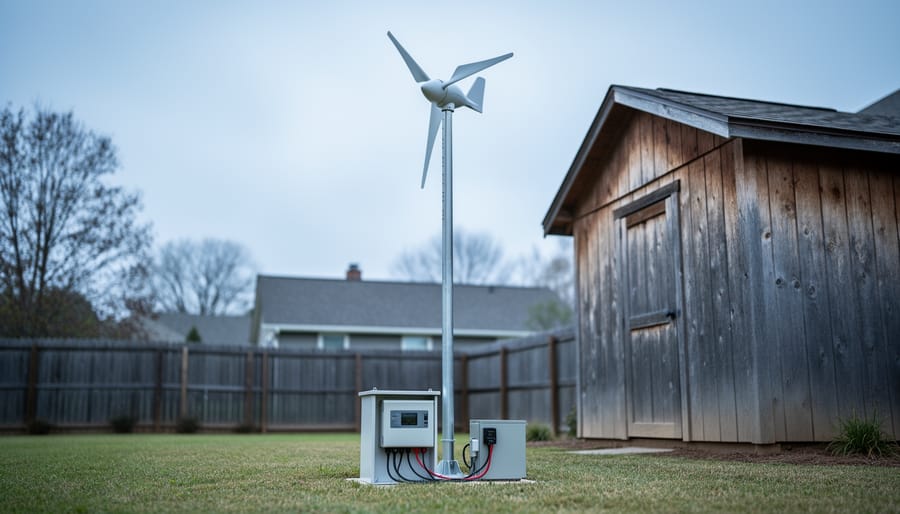
Home wind turbine kits with battery banks provide a complete off-grid power solution, typically pairing a 400-1200W turbine with a matched charge controller and 12V or 24V battery array to generate and store electricity for RVs, cabins, or residential backup systems. The right combination depends on three critical factors: your daily energy consumption (measured in watt-hours), the average wind speed at your installation site, and whether you need a standalone wind system or a hybrid setup that integrates solar panels.
In 2026, complete kits range from compact 100W systems designed for trickle-charging boat batteries to robust 1200W configurations capable of powering essential appliances during grid outages. Most residential applications fall into the 400-800W category, where turbines like the VEVOR 800W 12V Wind Turbine Generator with MPPT controller deliver meaningful power output at wind speeds above 6-7 mph. The battery bank serves as your energy reservoir, smoothing out the intermittent nature of wind generation and ensuring power availability during calm periods.
Understanding how these three components work together prevents the most common mistake: buying an oversized turbine that never reaches its rated output in your local wind conditions. A 1200W turbine sounds impressive, but if your site averages 8 mph winds, you’ll harvest far less energy than a properly sized 400W unit optimized for lower wind speeds. The controller acts as the critical interface, converting the turbine’s variable AC output to regulated DC charging voltage while protecting your batteries from overcharge damage.
This guide walks through component compatibility, compares kit categories by application, and provides sizing formulas to help you select a system that actually delivers the off-grid independence you’re planning for.
What Makes a Complete Wind Turbine Kit with Battery Bank
Understanding Power Output and Battery Voltage
Wind turbine wattage ratings represent the maximum power a unit can generate under ideal conditions, typically at sustained wind speeds between 25 and 35 mph. In reality, a 1200W turbine might average 200 to 400 watts throughout the day depending on your location’s wind resource, while a 400W model may deliver 50 to 100 watts of usable energy. This gap matters because you’re sizing your battery bank for actual production, not peak capacity. A 12V 1200W kit priced around $112 will generate far less energy in a 10 mph average wind site than its nameplate suggests, so calculate your needs based on conservative output estimates.
Matching turbine voltage to your battery system is non-negotiable. A 12V turbine charges 12V batteries, a 24V unit requires 24V banks, and 48V systems demand corresponding voltage alignment, mismatches prevent charging entirely or damage controllers. Most entry-level kits operate at 12V, suitable for RVs, cabins, and small indoor solar lights or appliances. Larger home systems benefit from 24V or 48V configurations, which reduce current flow and allow thinner wiring over longer distances. Higher voltages also improve efficiency in hybrid setups combining wind and solar, making 24V the sweet spot for supplemental home power and 48V the choice for serious off-grid installations.
The Role of Charge Controllers
Charge controllers serve as the critical interface between your wind turbine and battery bank, preventing overcharging and regulating voltage to protect your energy storage investment. Without proper regulation, batteries face shortened lifespan or catastrophic failure from voltage spikes during high winds.
MPPT (Maximum Power Point Tracking) controllers represent the advanced option, continuously adjusting input resistance to extract maximum energy from your turbine across varying wind speeds. They deliver 15-30% more charging efficiency than standard PWM (Pulse Width Modulation) controllers, especially when turbine voltage exceeds battery voltage. This efficiency gap matters most for larger systems where every watt counts toward offsetting grid dependence.
PWM controllers offer a simpler, budget-friendly approach for smaller kits under 400W. They regulate voltage by rapidly switching the turbine connection on and off, maintaining safe battery charging levels. While less efficient than MPPT technology, they cost considerably less and work reliably for basic cabin or RV applications.
Advanced controllers add dump-load management, a crucial feature for wind turbines. When batteries reach full charge, excess energy diverts to a resistive load rather than forcing the turbine to spin freely, which prevents mechanical stress and captures usable power for heating or auxiliary applications.
Voltage regulation matters because wind turbines produce wildly variable output. A quality controller smooths these fluctuations, delivering consistent charging current that extends battery bank life and prevents damage from sudden gusts.
Types of Home Wind Turbine Kits Compared

Home wind turbine kits fall into three main categories, each tailored to specific energy demands and installation scenarios. Understanding these distinctions helps you match the right system to your power needs without overspending on capacity you won’t use or underestimating what your setup requires.
Micro wind turbine kits ranging from 100W to 400W serve cabins, RVs, boats, and remote applications where modest energy storage matters more than powering large appliances. These compact systems typically feature three to five blades and start generating power in winds as low as 2.5 m/s (roughly 5.6 mph). A 100W kit paired with a 12V battery bank can maintain LED lighting, charge phones, and run small electronics in an off-grid cabin. The smaller rotor diameter (under one meter) makes them manageable for DIY installation on existing structures or portable mounts, and their lightweight design suits mobile applications where weight restrictions apply.
Mid-range systems delivering 600W to 1200W provide supplemental home power or serve as primary energy sources for well-insulated small homes with efficient appliances. The 12V 1200W kits currently available, priced around $111.98, use five-blade designs that capture energy across a wider wind speed range while maintaining that crucial 2.5 m/s start-up threshold. These units typically connect to 12V or 24V battery banks and can offset a meaningful portion of household consumption when sited in areas with consistent winds. At 800W, options like the VEVOR kit at $139.90 include MPPT controllers that optimize charging efficiency, squeezing 20 to 30 percent more usable power from variable wind conditions compared to basic PWM controllers.
| Kit Type | Wattage Range | Best Applications | Typical Start-Up Speed | Battery Voltage |
|---|---|---|---|---|
| Micro Kits | 100W, 400W | Cabins, RVs, boats, remote sensors | 2.5-3.0 m/s | 12V |
| Mid-Range Systems | 600W, 1200W | Supplemental home power, small off-grid homes | 2.5-3.5 m/s | 12V, 24V |
| Hybrid Wind-Solar Kits | 800W+ combined | Off-grid homesteads, farms, reliable backup power | 2.5-3.0 m/s | 12V, 24V, 48V |
Hybrid wind-solar kits combine turbines with photovoltaic panels to smooth out energy production across different weather patterns and times of day. An 880W system pairing wind and solar components addresses the intermittency problem: when winds drop at night, stored solar energy fills the gap, and when clouds block the sun, wind generation continues. These integrated kits often support 24V or 48V battery banks, which reduce current loads and allow for more efficient long-distance cable runs between components. The trade-off is added complexity in controller selection and system balancing, but the reliability gain makes hybrids the preferred choice for off-grid living where consistent power availability isn’t negotiable.
Blade count influences performance characteristics more than raw power ratings suggest. Three-blade turbines spin faster and reach rated output sooner in moderate winds, while five-blade designs generate more torque at lower speeds, making them better suited to areas with light, variable breezes. Start-up wind speed matters critically in real-world performance; a turbine rated for 1200W but requiring 4 m/s to begin spinning will sit idle far more often than a 600W unit that starts at 2.5 m/s, potentially delivering more cumulative energy over a season despite the lower nameplate rating.
Key Buying Factors for Wind Turbine Kits with Battery Banks
Choosing the right wind turbine kit with battery bank starts with honest assessment of your actual energy needs, not wishful thinking about power production. Calculate your daily watt-hours by listing every device you’ll run off the system, lights, fridge, phone chargers, water pump, and how long each operates. A 400-watt turbine running at full capacity for six hours produces 2,400 watt-hours, but real-world output swings wildly with wind speed, so size conservatively and account for seasonal variation.
Voltage compatibility between turbine, controller, and battery bank is non-negotiable. Most kits operate at 12V, 24V, or 48V; the entire system must match. A 12V turbine works perfectly for small RV setups with modest loads, but larger home systems demand 24V or 48V to reduce current flow and minimize power loss through wiring. Mixing voltages damages equipment and creates fire hazards, so verify specifications before purchasing.
- Wattage needs: Add up your daily watt-hours, then multiply by 1.5 to account for inefficiencies and low-wind days
- Voltage matching: Ensure turbine, charge controller, and battery bank all operate at the same voltage (12V, 24V, or 48V)
- Controller type: Choose MPPT for maximum energy harvest (15-30% more efficient than PWM), especially on variable wind sites
- Start-up wind speed: Look for 2.5-3 m/s or lower; higher thresholds mean the turbine sits idle during light breezes
- Installation complexity: Factor in tower height (minimum 30 feet above obstructions), concrete foundation work, and local zoning permits
Blade design directly affects how much energy you capture. Three-blade turbines offer quieter operation and smoother rotation, while five-blade models like the 1200W kit at $111.98 start spinning in gentler winds but generate more noise. Start-up speed matters enormously, a turbine rated for 2.5 m/s begins producing power in light breezes, whereas a 5 m/s model waits for stronger gusts that may arrive infrequently.
Build quality separates reliable systems from scrap metal. Marine-grade aluminum blades, stainless hardware, and weatherproof nacelles survive coastal salt spray and temperature swings. Check customer reviews for longevity reports; a controller rated for outdoor use still fails if moisture seeps into cheap connections. The VEVOR 800W kit at $139.90 includes an MPPT controller and three-phase AC generator, indicating better component integration than bargain assemblies.
Expandability lets you start small and grow. Hybrid-ready controllers accept both wind and solar input, so you can add panels later when budget allows. Battery bank sizing should accommodate future turbines, begin with enough capacity for three days of autonomy at current usage, but wire in space for additional batteries as your energy demands increase.
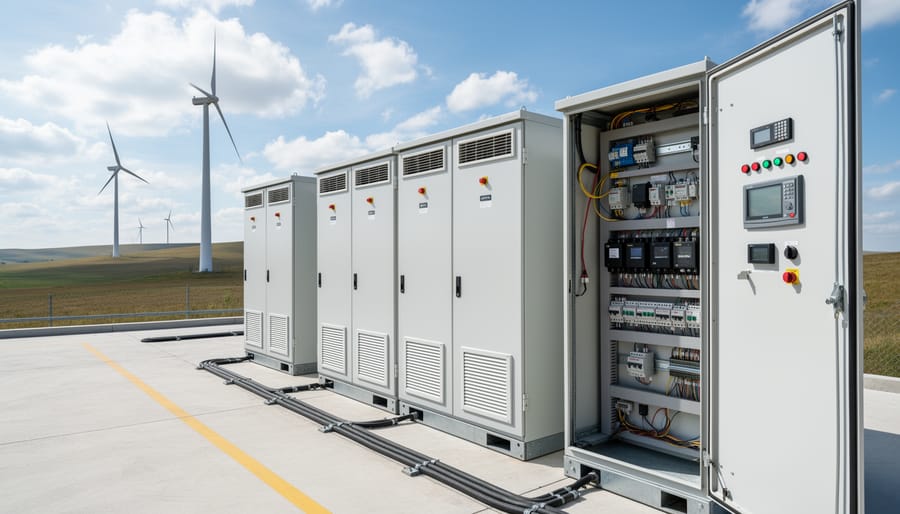
Victron Energy SmartSolar MPPT Solar Charge Controller 100V

The Victron Energy SmartSolar MPPT 100V 50A represents the premium tier of charge controllers for homeowners building serious hybrid renewable systems. If you’re pairing a mid-to-large wind turbine with a solar array to charge a 12V or 24V battery bank, this controller delivers the efficiency and intelligence to squeeze every available watt from both sources.
Maximum Power Point Tracking technology is where Victron separates itself from budget controllers. The unit continuously calculates the optimal voltage-current combination to harvest up to 30% more energy compared to standard PWM controllers, critical when wind speeds fluctuate or clouds drift across your panels. It automatically detects whether your battery bank is 12V or 24V, eliminating manual voltage selection and configuration headaches during installation.
The built-in Bluetooth monitoring via the VictronConnect app transforms system management. You can track real-time power flow from your turbine and panels, review historical charging data, and adjust charging profiles from your phone without climbing a ladder to access the controller. For hybrid setups combining a 600W, 1200W wind turbine with a comparable solar array, this visibility helps you understand which source carries your load during different weather patterns.
This controller handles up to 1,450W on a 24V system (725W on 12V), providing headroom for larger turbine-solar combinations without hitting the current ceiling. The unit is currently in stock, though serious off-gridders should note that Victron’s build quality and smart features command a price premium over generic MPPT controllers, an investment that pays dividends in energy harvest and battery longevity.
Victron Energy SmartSolar MPPT 100V 30 amp 12/24-Volt Solar Charge

The Victron Energy SmartSolar MPPT 100V 30A controller bridges the gap between entry-level units and the larger 50A model, making it ideal for mid-sized wind-solar hybrid setups that demand precision and reliability. Its 30-amp capacity handles combined inputs from moderate wind turbines and solar arrays, while automatic 12/24V battery detection eliminates manual configuration errors that plague cheaper controllers.
What sets this unit apart is its Bluetooth app control, which transforms system monitoring from guesswork into real-time data. You can track charging current, battery voltage, and daily energy yield from your phone, spotting performance issues before they drain your battery bank. The VictronConnect app lets you program custom charging profiles tailored to your specific battery chemistry, critical when lithium and AGM batteries have vastly different absorption and float voltage requirements.
The MPPT algorithm continuously optimizes power extraction from both wind and solar sources, even when conditions shift rapidly. During variable wind days or partial cloud cover, this controller adjusts dozens of times per second to maximize harvest while preventing overcharge damage. Its adaptive three-stage charging (bulk, absorption, float) protects your battery bank from the voltage spikes that shorten lifespan in poorly-regulated systems.
Temperature compensation and load disconnect features add layers of protection that basic PWM controllers skip entirely. The compact design mounts easily in tight spaces like RV battery compartments or off-grid cabin walls. With only 11 units currently in stock, this controller’s popularity reflects its reputation among serious renewable energy adopters who refuse to compromise on battery protection or harvest efficiency.
Victron Energy SmartSolar MPPT Solar Charge Controller 75V

The Victron Energy SmartSolar MPPT 75V 15A controller strikes an ideal balance between advanced charging technology and compact design for entry-level wind-solar hybrid systems. Its 75V input ceiling and 15A output make it perfectly sized for smaller wind turbine kits, typically 100W to 400W models, paired with modest solar panel arrays on cabins, RVs, and boats where space and budget matter.
What sets this controller apart is its intelligent MPPT tracking algorithm, which continuously scans for the optimal operating point to extract maximum power from both wind and solar inputs as conditions change throughout the day. The 12/24V automatic voltage detection adapts seamlessly to your battery bank configuration, while built-in Bluetooth connectivity lets you monitor harvest, battery state, and charging history through Victron’s free smartphone app, eliminating guesswork about system performance.
The unit’s compact footprint (roughly the size of a paperback book) simplifies installation in tight spaces like RV utility bays or cabin crawlspaces. Advanced features including temperature compensation, programmable charging profiles, and adaptive multi-stage charging protect batteries from the overcharge and sulfation that plague simpler controllers, extending battery lifespan significantly.
For modest energy demands, running LED lights, charging devices, powering a refrigerator during calm periods, this controller delivers professional-grade regulation at an accessible price point. It addresses common solar panel disadvantages by integrating wind power to fill generation gaps during cloudy stretches, making it an excellent foundation for reliable off-grid power.
30A MPPT Solar Charge Controller

This affordable 30A MPPT controller delivers essential charging intelligence for budget-conscious wind-battery builders without sacrificing performance. With a 4.2-star rating from 2,547 users, it’s proven itself across thousands of DIY installations where cost and straightforward operation matter most.
The built-in LCD display provides real-time monitoring of charging current, battery voltage, and power output, valuable feedback for troubleshooting wind turbine installations and understanding daily energy harvest. Auto-parameter adjustment automatically configures charging profiles based on detected battery type, eliminating guesswork during setup and reducing the risk of improper charging that shortens battery life.
For DIY wind-battery systems, this controller offers a compelling balance of capability and value. The MPPT technology extracts 20-30% more energy from your turbine compared to basic PWM controllers, especially during variable wind conditions when maximum power point tracking makes the biggest difference. The 30A current rating handles turbines up to roughly 360W at 12V or 720W at 24V, covering most entry-level and mid-range kits.
Installation is straightforward: clearly labeled terminals for turbine input, battery output, and load connections minimize wiring errors, while the display confirms proper operation immediately. The controller is in stock and represents an accessible entry point for anyone building a wind-battery system who wants monitoring and efficiency gains without the premium price of Victron or other high-end brands. It’s particularly well-suited for RV, cabin, and boat applications where space is tight and every watt of captured wind energy counts.
1400W Off Grid

The 1400W Off Grid hybrid controller represents a practical solution for homesteaders and off-grid enthusiasts looking to combine wind and solar energy in a single battery charging system. This unit handles up to 800 watts from a wind turbine generator plus 600 watts of solar panels simultaneously, routing both sources through intelligent charge management to your battery bank. With a 4.4-star rating from 147 customer reviews, it’s earned solid credibility among users running mixed renewable setups.
The controller’s auto 12/24V battery detection eliminates manual voltage selection, it recognizes your battery bank configuration and adjusts charging parameters accordingly. It employs boost-float charging, which first rapidly charges depleted batteries to around 80 percent capacity (boost phase), then switches to a gentler float charge to top them off without overcharging. This two-stage approach extends battery lifespan while ensuring thorough energy capture from variable wind and sun conditions.
Safety features include an unloader function that protects both the turbine and batteries during high-wind events. When batteries reach full charge or wind speeds spike dangerously, the controller diverts excess power to prevent turbine overspin and battery damage, critical protection for unattended off-grid installations.
The real-world fit for this controller centers on small homesteads, remote cabins, and rural properties where grid connection isn’t practical or desired. It simplifies system design by handling both energy sources through one device, reducing wiring complexity and potential failure points. Currently, only 20 units remain in stock, reflecting steady demand for capable hybrid controllers in 2026’s expanding off-grid market.
wind turbine generator kits
Generator kits in 2026 span a wide output range, from compact 100W micro-turbines suited for battery trickle charging on boats and RVs, up to 1200W+ models capable of meeting substantial daily energy needs when paired with appropriately sized battery banks. Entry-level 100W kits include the essentials, turbine, wind charge controller, and hardware, for around $50 to $80, making them accessible for first-time wind energy adopters testing the waters on cabins or vehicles. These micro-systems work best as supplemental charging rather than primary power sources.
Mid-sized options offer better value for off-grid applications. The 12V 1200W kit, priced at $111.98 and in stock, features 5 blades and a 2.5 m/s low start-up speed, allowing it to capture energy in light breezes that would leave three-blade designs idle. Its integrated voltage regulation and automatic yaw adjustment simplify installation, though its 3.8-star rating from 18 users suggests build quality or noise concerns worth investigating in reviews. For slightly more investment, the VEVOR 800W 12V kit at $139.90 includes an MPPT controller and 3-phase AC permanent magnet generator, delivering higher efficiency through optimized battery charging.
Remember that wind speed affects power exponentially, a turbine rated for 800W at 12 m/s might produce only 150W at 6 m/s, so match your kit’s rated output to realistic wind conditions at your site, not maximum specs. Complete systems bundle mounting towers, guy wires, and hardware for 12V, 24V, or 48V battery configurations. The 880W hybrid solar-wind kit targets farms, homes, and RVs needing redundant charging across weather conditions, while 24V models like the 800W BLACK kit suit larger battery banks and higher voltage systems common in off-grid homesteads.
Omni Nova Home Systems
Omni Nova positions itself in the integrated home energy market by offering turnkey systems that combine wind turbines, solar panels, battery banks, and charge controllers in coordinated packages designed for whole-home backup power. Their approach targets homeowners who want renewable energy without the complexity of sourcing and matching individual components from multiple manufacturers.
The company’s systems typically bundle a mid-range wind turbine (often in the 600W, 1200W range) with complementary solar capacity, creating hybrid setups that generate power during both windy and sunny conditions. This dual-source design addresses the intermittency challenge inherent in single-technology systems. Battery banks are pre-sized to match the combined output, and controllers are selected to handle both wind and solar inputs while protecting the batteries from overcharge.
Omni Nova emphasizes simplified installation through pre-wired components and detailed setup guides, though homeowners still need to install a wind turbine tower and mount solar arrays according to local wind resources and sun exposure. The systems include monitoring capabilities that track production from both sources, battery state-of-charge, and household consumption patterns.
For whole-home backup scenarios, Omni Nova’s larger configurations integrate with grid-tied inverters, allowing excess production to offset utility power while maintaining battery reserves for outages. This approach appeals to homeowners seeking energy independence without abandoning grid connection entirely. The primary tradeoff is higher upfront cost compared to assembling a DIY system from individual marketplace components, though the integration assurance and unified warranty coverage justify the premium for many buyers.
charge controller
Choosing the right charge controller is arguably the most critical decision in a wind turbine battery system. It sits between the raw, fluctuating output of your turbine and the sensitive battery bank, regulating voltage, preventing overcharge, and maximizing energy harvest. Get it wrong, and you’ll either damage expensive batteries or waste precious wind energy.
MPPT vs PWM: The Efficiency Debate
MPPT (Maximum Power Point Tracking) controllers actively monitor your turbine’s output and adjust voltage to extract maximum power under varying wind conditions. They typically deliver 15-30% more energy than PWM (Pulse Width Modulation) controllers, especially when wind speeds fluctuate or you’re running a 24V or 48V battery system. PWM controllers are simpler and cheaper, they essentially switch the turbine on and off to regulate voltage, but they can’t adapt to changing conditions like MPPT can.
For small 12V systems under 400W, PWM may suffice. Anything larger, or if you’re building a hybrid setup alongside panels (like the solar setup timeline or solar flood lights integration), invest in MPPT.
Wind-Specific Features Matter
Wind turbines demand different handling than solar. Look for controllers with dump-load capability, when batteries reach full charge, the controller diverts excess energy to a resistive load (like a heater) instead of braking the turbine, which can damage the generator. Auto-braking circuits protect against overspeed in high winds.
Sizing to Your System
Match controller amperage to your turbine’s maximum output current, not just rated wattage. A 1200W turbine on a 12V system can push 100A in strong wind; undersizing the controller creates a bottleneck. Add 25% headroom for safety and future expansion, especially if you plan to add solar later.
Sizing Your Battery Bank for Wind Energy Storage
Sizing your battery bank correctly separates a reliable wind energy system from one that leaves you in the dark during calm periods. Start by calculating your daily energy consumption in watt-hours: tally up every device you plan to power, multiply each wattage by its daily run time, and add them all together. If you use 2,000 watt-hours per day, that’s your baseline.
Next, decide your autonomy requirement, how many days you want the battery bank to sustain your loads without wind input. Two to three days is the minimum for most off-grid applications; rural cabins in variable wind zones may want four or five. Multiply your daily consumption by autonomy days to get total capacity needed (2,000 watt-hours × 3 days = 6,000 watt-hours).
Now factor in depth-of-discharge limits. Lead-acid batteries should only discharge to fifty percent to preserve lifespan, so double your capacity requirement: 6,000 watt-hours becomes 12,000 watt-hours, or 1,000 amp-hours at 12 volts. Lithium batteries tolerate eighty to ninety percent discharge, meaning you can use a smaller, lighter bank, 7,500 watt-hours yields the same usable energy. Lithium costs more upfront but lasts two to three times longer and handles partial-state charging from variable wind far better than lead-acid, which suffers when cycled shallowly or left partially charged.
Voltage selection matters, too. Twelve-volt systems work fine for micro turbines under 400 watts and minimal loads like RV lighting or memorial solar lights but losses mount fast at higher currents. Twenty-four-volt banks suit mid-range turbines (600W, 1200W) and reduce wire gauge requirements; forty-eight-volt systems are ideal for larger installations where efficiency and future expansion matter. Match your turbine’s native voltage to avoid conversion losses, and remember that doubling voltage halves the current for the same power, cutting resistive losses in half.
Smart Recommendations Based on Your Energy Needs
Matching the right wind turbine kit to your specific energy demands prevents both overspending and under-performance. Here’s how to align your purchase with real-world use cases.
For weekend cabins and minimal-load applications, a 100W, 400W micro kit with a 12V battery bank handles LED lighting, phone charging, and small electronics. The 100W mini turbine kits currently available pair well with a single 100Ah deep-cycle battery and a basic 10A, 15A MPPT controller. These compact systems typically cost $100, $200 and produce enough energy to keep essential devices running during multi-day visits. Install them following the wind turbine steps for proper mounting height and safety.
Mid-range systems (600W, 1200W) suit supplemental home power and battery charging for homes that want to offset grid consumption or provide backup for critical circuits. The 12V 1200W kits at $111.98 or VEVOR 800W systems at $139.90 work with 24V battery banks (two 12V batteries in series) and require 30A, 50A MPPT controllers. Size your battery bank to 200-400Ah for adequate storage, allowing 2-3 days of autonomy during low-wind periods.
Hybrid wind-solar kits deliver the most reliable off-grid power by capitalizing on seasonal variation, wind often peaks when solar production drops. Consider these configurations:
- Weekend cabin: 200W turbine + 200W solar + 200Ah 12V battery bank + 20A hybrid controller
- Full-time RV: 800W turbine + 400W solar + 400Ah 24V battery bank + 50A MPPT controller
- Partial home backup: 1200W turbine + 800W solar + 800Ah 48V battery bank + dual 50A controllers
The 880W solar-wind hybrid kits currently on the market simplify component matching, bundling compatible turbines, panels, and controllers. For off-grid homesteads, invest in 48V systems, they reduce wire losses on longer runs from turbine to battery bank and support higher power loads like well pumps and refrigeration. Always add 20-30% capacity margin to your calculations; wind output varies more than solar, so oversizing your battery bank ensures you capture energy during gusty periods without wasting it.
Common Mistakes to Avoid When Buying Wind Turbine Kits
The most expensive mistake is buying a turbine before assessing your site’s actual wind resource. A 1200W turbine marketed for $111.98 will produce almost nothing in a location averaging below 10 mph wind speeds, regardless of its rated capacity. Many buyers skip this step entirely, relying instead on turbine specifications that assume ideal conditions. Without measuring wind speeds at the proposed installation height for at least a month, you’re purchasing blind.
Several critical errors can doom even a well-planned wind-battery system:
- Underestimating wind requirements: Installing turbines in locations with average wind speeds below 9 mph, where output drops to 10-20% of rated capacity
- Voltage mismatches: Connecting a 24V turbine to a 12V battery bank without proper conversion, damaging both components
- Controller shortcuts: Choosing a basic PWM controller to save $40-60, losing 15-25% efficiency compared to MPPT technology over the system’s lifetime
- Installation height neglect: Mounting turbines at roofline height where buildings create turbulence, instead of the recommended 30 feet above nearby obstructions
- Rated-wattage fantasy: Expecting a 800W turbine to consistently deliver 800W, when real-world output averages 30-40% of peak rating in variable wind
- Battery incompatibility: Pairing wind turbines with car batteries or cheap marine batteries that cannot handle the irregular charging cycles
- Maintenance avoidance: Failing to budget for annual bearing inspections, blade balancing, and battery equalization cycles
Zoning regulations present another frequently overlooked obstacle. Many jurisdictions restrict turbine height, setback distances, and noise levels. Discovering your planned installation violates local codes after purchasing equipment wastes both money and time. Check permitting requirements before ordering, not after delivery.
The rated wattage trap catches nearly every first-time buyer. That VEVOR 800W kit priced at $139.90 will only approach 800 watts in sustained 25-30 mph winds, conditions that occur infrequently in most residential areas. Real-world daily production typically ranges from 1-3 kWh in moderate wind sites, not the 19 kWh suggested by multiplying 800W by 24 hours. Understanding this gap between marketing numbers and actual performance prevents disappointment and helps you size battery banks realistically.
Frequently Asked Questions
Can a home wind turbine charge batteries on low-wind days?
Most turbines produce minimal power below their rated wind speeds, typically generating only 10-20% of capacity in light winds (under 8 mph). Quality MPPT controllers help capture what energy is available, but expect limited charging on calm days, this is why hybrid systems or grid backup make sense for consistent power needs.
What battery type works best with wind turbine kits?
Lithium iron phosphate (LiFePO4) batteries offer the best performance with deeper discharge cycles, faster charging, and longer lifespan (10+ years), though they cost more upfront. Sealed AGM lead-acid batteries provide a budget-friendly alternative for systems with lower daily cycling demands, typically lasting 3-5 years with proper maintenance.
Do I need a hybrid wind-solar system?
Hybrid systems provide more reliable power since wind often peaks at night and during storms when solar production drops, while sunny days may have calm winds. If consistent battery charging matters for your application, combining both sources significantly reduces the risk of extended low-production periods.
How loud are residential wind turbines?
Small turbines (under 1kW) typically produce 35-45 decibels at ground level in moderate winds, roughly equivalent to a refrigerator hum. Noise increases with wind speed and blade tip velocity, so proper installation height and distance from living spaces matters, place turbines at least 30 feet from your home and check local noise ordinances before installation.
Installation difficulty varies with kit completeness and your DIY experience. Pre-assembled turbines with detailed instructions can be mounted by handy homeowners with basic electrical knowledge, especially ground-level or roof mounts. Tower installations above 20 feet often require professional help for safety and structural integrity, plus electrical work may need inspection depending on your local codes. Start with smaller kits to build confidence before tackling larger systems.
Investing in a home wind turbine kit with battery bank represents a meaningful step toward energy independence and environmental stewardship. By harnessing wind power, you reduce reliance on fossil fuels, lower your carbon footprint, and create a resilient energy system that works even during grid outages. The technology has matured significantly, and 2026 offers accessible, well-engineered options for homeowners ready to embrace renewable energy.
Success hinges on matching components correctly. Your turbine voltage must align with your battery bank, and your charge controller must handle the power output while protecting your batteries from overcharge. Equally critical is assessing your site’s actual wind resource, installing a turbine in a low-wind location wastes money and generates frustration. Take time to measure average wind speeds at your planned installation height before committing to a system.
Quality matters, especially in controllers. A reliable MPPT controller extracts maximum energy from variable winds and extends battery lifespan through proper voltage regulation. Don’t compromise here.
Start with a modest system matched to your current needs, then expand as you gain experience. A 400W turbine with a properly sized battery bank teaches you the rhythms of wind energy without overwhelming investment. You can always add capacity later or integrate solar panels for hybrid reliability. The path to energy independence begins with that first rotation of the blades.
We link to products we cover, and some of those links pay us a commission if you make a purchase. As an Amazon Associate I earn from qualifying purchases.


